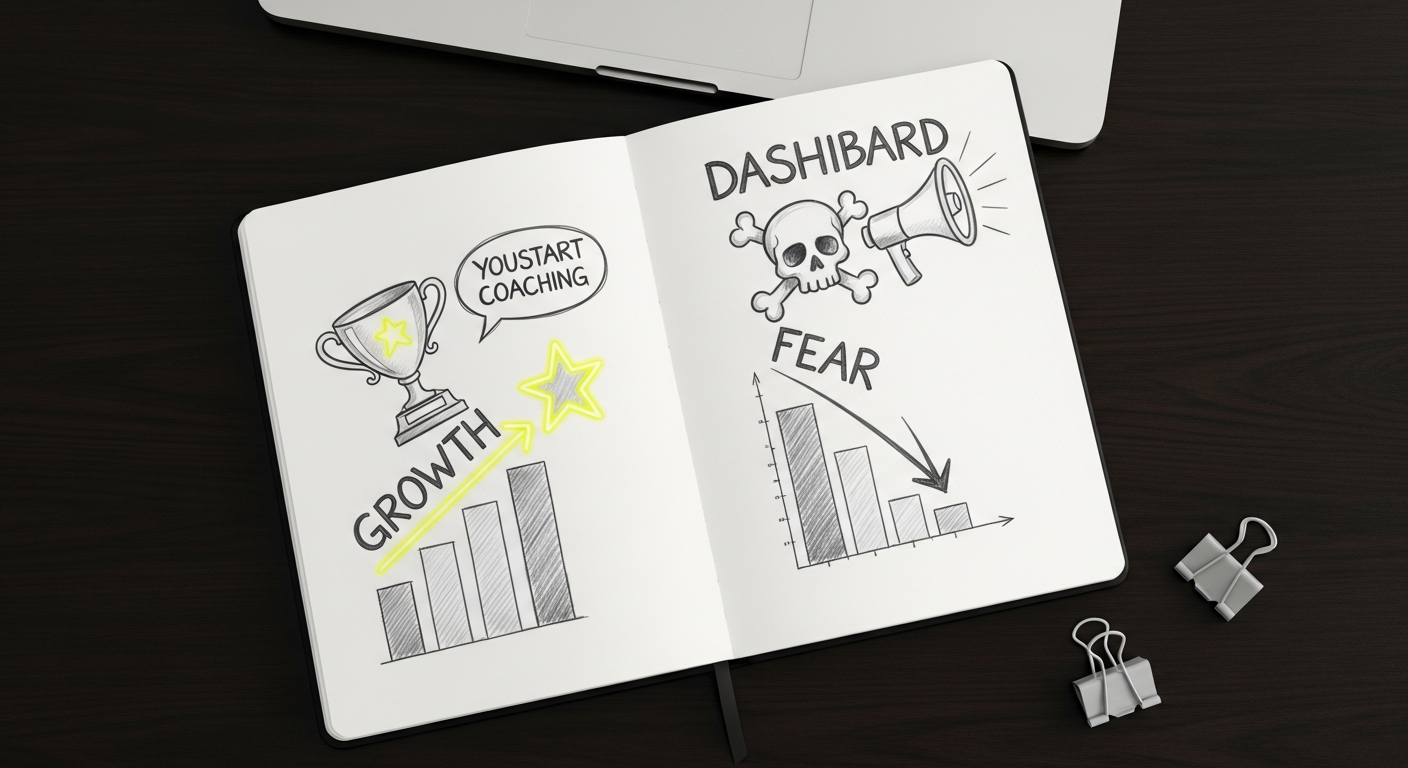
The Psychology of Public Sales Dashboards: Accountability or Public Shaming?
Your sales dashboard is either building your team or breaking it. There is no neutral.
Public performance dashboards sit at the center of a tension every sales organization faces. On one side: nearly 90% of sellers report burnout[2] and sales turnover runs at nearly 3x the all-industry average.[11] On the other: a 2024 Journal of Marketing study of 27,000+ salespeople across 83 countries found that identifiable performance rankings can simultaneously boost quota attainment and reduce turnover, when implemented correctly.[1]
The difference between a motivating dashboard and a soul-crushing one isn't the data you display. It's the culture underneath it. Harvard Business School professor Amy Edmondson's research shows that accountability and psychological safety aren't opposing forces. They're complementary dimensions that together create high performance.[4] Get that combination wrong, and you build what she calls the "Anxiety Zone," where reps game metrics, hide struggles, and quietly update their resumes.
This article examines what the research actually says about public performance metrics in sales, why most organizations get the implementation wrong, and what the evidence suggests about building dashboards that drive performance without destroying the people producing it.
Table of Contents
What Does Psychology Say About Ranking People Publicly?
Social comparison theory, established by Leon Festinger in 1954, explains why leaderboards trigger such powerful emotional responses.[13] Humans have a fundamental drive to evaluate themselves against others, and workplace rankings supercharge this instinct. A 2025 review in the Journal of Management found that "organizational life is a comparative life," but the outcomes depend heavily on context. Comparisons to better-compensated or higher-ranked peers produce envy, reduced willingness to help colleagues, and even cheating behavior.
Shame: "I am bad"
Shame corrodes the part of people that believes they can change. When public rankings make struggling reps feel they are failures rather than having experienced failure, the psychological damage compounds. People shut down, disengage, or leave.[6]
Guilt: "I did something bad"
Guilt, by contrast, can motivate repair. When the message is "this result fell short" rather than "you fell short," reps can separate their identity from their performance and take action. As Brene Brown writes: "The difference between 'I am a screwup' and 'I screwed up' may look small, but in fact it's huge."[6]
What the Largest Study on Sales Rankings Found
A landmark 2024 Journal of Marketing study analyzed sales performance rankings across 170+ firms in 83 countries.[1] The findings challenge simple narratives about whether public rankings help or hurt:
Anonymous rankings improve quota attainment but significantly increase turnover. Reps perform better in the short term but leave faster. The pressure motivates, but without social connection, it also isolates.
Identifiable rankings without quotas work best , simultaneously elevating performance and reducing departures. When salespeople know their peers' identities in rankings, they're motivated by both self-improvement and social image maintenance. The dual motivation creates sustained effort without the isolation of anonymous competition.
Adding quota information to identifiable rankings erased the retention benefit. When reps see exactly where they stand relative to a target alongside their peers, the social comparison becomes punishing rather than motivating.
Self-Determination Theory, developed by Deci and Ryan, explains why external pressure often backfires. The theory identifies three psychological needs essential for intrinsic motivation: autonomy, competence, and relatedness. Public leaderboards typically create "controlled motivation" driven by external pressure rather than "autonomous motivation" driven by genuine interest. That explains why they can boost short-term activity while eroding long-term engagement.
The Sales Turnover Crisis by the Numbers
Sales organizations hemorrhage talent at rates that should alarm every leader reviewing a performance dashboard. The numbers paint a picture of an industry where management practices drive attrition as much as market conditions do.
Annual sales turnover vs. 13% all-industry average[11]
Average cost to replace one sales rep[12]
Of reps don't expect to meet quota this year[3]
Missed quota last year[3]
The 2024 Salesforce State of Sales report, surveying 5,500 respondents across 27 countries, reveals that management practices directly drive attrition.[3] Top reasons reps consider leaving include lack of career advancement, unrealistic targets, and insufficient autonomy. When two-thirds of your reps don't expect to hit quota, the problem isn't individual performance. It's systemic target-setting.
Gallup's research adds a critical dimension: 70% of the variance in team engagement stems from the manager.[5] The sales dashboard is the manager's most visible tool for communicating expectations. When that tool communicates "you're failing" instead of "here's where you can grow," the engagement impact cascades through the entire team.
The coaching gap makes this worse. Objective Management Group's assessment of 2.5 million sales professionals found that only 7% of sales managers have the capabilities to coach effectively and consistently.[8] Most default to the dashboard as a management substitute: point at the numbers, apply pressure, repeat. When 93% of managers lack effective coaching skills (a problem that structured sales training programs can address), the dashboard becomes the primary management tool by default, and it's doing damage without anyone realizing it.
When Do Performance Dashboards Become Toxic?
Anthony Iannarino, author of four bestselling sales books, identifies the root cause of most toxic sales cultures: "The leader's use of fear. Instead of inspiring and influencing their sales force, this leader uses threats and coercion. The salespeople who know their worth walk away."
His observation about relationship degradation cuts deep: "After four years of working together, his manager didn't know he had three children. Instead of focusing on what motivated the salesperson, the manager focused on the results alone." When a dashboard replaces the human relationship between manager and rep, it reduces people to numbers on a screen.
Signs Your Dashboard Culture Has Gone Wrong
Leaderboard fatigue
What was meant to boost morale becomes a constant reminder of missed targets. Reps stop looking at the board entirely. Industry analysts describe this as the point when "sales team members become demotivated or disengaged due to the constant pressure of leaderboard rankings."
Activity metric gaming
Reps log calls that don't happen, send emails that aren't read, and create meetings that don't matter. ExpressVPN research found that 25% of workers research hacks to fake productivity when facing monitoring.[9] The dashboard shows green numbers while actual performance declines.
Collaboration collapse
Northwestern's Kellogg School of Management research confirms the mechanism: "The internal competition associated with relative ranking is not for everyone. It can push out otherwise excellent employees who are averse to the dog-eat-dog culture."[10] Nobody wants their colleagues to succeed when that success comes at your expense.
Micromanagement spiral
Daniel Disney, founder of The Daily Sales, captures the pattern: "Sales managers begin to watch your EVERY move, counting the calls you make, listening to them, critiquing your every move... Instead of putting MORE pressure on them, perhaps try to take some pressure AWAY." Employees facing both online and physical monitoring report 45% higher stress levels than those in less-surveilled environments.[9]
The Microsoft Lesson
Microsoft abandoned stack ranking in 2013 after analysis showed it created an environment where "employees start spending more time thinking about their ranking and where they stand in relation to their coworkers" rather than producing their best work. The company's cultural transformation under Satya Nadella, which emphasized growth mindset over forced rankings, preceded one of the most successful corporate turnarounds in tech history.
When Does Transparency Actually Work?
The research doesn't uniformly condemn public metrics. It condemns thoughtless implementation. The same leaderboard can motivate or demoralize depending on context, framing, and the culture around it.
Gamification produces real results when framed correctly
HP reported a 30-42% revenue increase over two months after deploying sales gamification. A Journal of Business Research study found gamification produced a 14% increase in sales performance, with the most significant improvements among initially below-average performers. The mechanism matters: competitions framed as earning prizes or recognition create excitement. Competitions framed as potential losses, humiliation, or losing status trigger anxiety and increase unethical behavior.
Trust is the prerequisite, not the result
Google's Project Aristotle studied 180+ teams and found that psychological safety was the #1 predictor of team effectiveness. Teams with high psychological safety were rated as effective twice as often by executives.[7] Dr. David Rock of the NeuroLeadership Institute reinforces: "Instead of being in conflict, psychological safety and accountability are actually two dimensions of high performance."[14]
Coaching cultures outperform surveillance cultures
A 2014 HCI/ICF study found that 51% of organizations with strong coaching cultures reported above-average revenue relative to their industry peers, compared to just 38% of those without.[8] Yet Objective Management Group's data shows only 7% of sales managers coach effectively. Most organizations default to metrics as a substitute for development, producing higher stress without higher performance.
Kristie Jones, with 20+ years in SaaS sales leadership, captures the principle: "Expectations are a two-way street. As a leader, I can't just sit down with you and say, 'Here are my expectations, let's negotiate them.' I also need to say, 'Here's what you can expect from me.'" She asks reps to define their own consequences for missing commitments, building ownership rather than imposing surveillance.
Edmondson's Four Zones: Where Does Your Team Sit?
Amy Edmondson's framework maps team dynamics across two dimensions: psychological safety and accountability.[4] Organizations exist in one of four states based on their combination. Most sales teams with heavy dashboard cultures sit in the Anxiety Zone without knowing it.
Apathy Zone
No motivation, bare minimum effort. People clock in and coast. Neither trust nor expectations exist.
Comfort Zone
People feel safe, but nothing pushes them to grow. Pleasant conversations, minimal output. Teams stagnate.
Anxiety Zone
Fear-based performance pressure without support. Reps game metrics, hide struggles, and burn out. This is what bad dashboards create.
Learning Zone
The ideal. People take risks, admit mistakes, hold each other accountable, and improve continuously. Public metrics work here.
The critical insight: accountability works only after psychological safety is established. Organizations that layer surveillance onto low-trust cultures create the Anxiety Zone, driving away talent while fostering "performance theater" rather than genuine productivity. Edmondson's research shows teams can move into the Learning Zone "when accountability for performance interacts with psychological safety."[4]
How to Build a Dashboard That Doesn't Destroy Your Team
The research points to specific design choices that separate motivating dashboards from toxic ones. None of these require removing measurement. They require measuring with intention.
Go beyond only recognizing top performers. Recognize desirable behaviors and activity levels, the things reps can control. A rep who conducts thorough prospect research, sends personalized outreach, and builds genuine relationships deserves visibility regardless of whether this quarter's close numbers reflect that effort yet. Include "most improved" categories alongside top-performer boards.
Raw revenue rankings punish reps with harder territories and reward those with easier ones. Percent-to-target normalizes across territories and makes the measurement about individual effort against individual goals. A rep at 90% of a stretch target is outperforming one at 100% of an easy target, and the dashboard should reflect that.
Individual competition kills knowledge-sharing. Team competitions that incentivize collaboration produce better outcomes than individual leaderboards alone. When your success depends partly on helping others succeed, the incentive to hoard leads and sabotage colleagues disappears. George Georgiadis at Northwestern's Kellogg School suggests rating employees on both their individual performance and their team's performance.[10]
Harvard Business School research shows that competitions framed as earning prizes, recognition, or benefits create excitement and exploration. Competitions framed as potential losses (missing bonuses, humiliation, losing status) trigger anxiety and increase unethical behavior. The language around your dashboard matters as much as the data on it. "You're 4th in pipeline created this month" lands differently than "You're in the bottom half of the team."
The dashboard should celebrate wins publicly. Struggles should be addressed in one-on-one settings where reps feel safe admitting challenges. Research from the CEB/Gartner shows that reps who receive just three hours of coaching per month exceed their goals by 7%, boosting revenue by 25% and increasing close rates by 70%. That three hours per month is only about 2% of a manager's workload, but it transforms the dashboard from a judgment tool into a development compass.
Traditional dashboards spotlight top performers who already thrive under pressure while potentially driving away the middle performers who have the most growth potential. Research suggests competition benefits roughly 50% of people, with 25% unaffected and 25% wilting under pressure. Dashboards designed to celebrate progress, not just peaks, capture the larger population that standard leaderboards ignore. "Most improved" boards, skill-based milestones, and coaching-focused metrics redirect attention toward development.
Frequently Asked Questions
The Dashboard Test
The question has never been whether to measure sales performance. Of course you measure it. The question is whether your measurement system builds people up or grinds them down.
Research across 27,000+ salespeople, hundreds of organizations, and decades of psychology converges on a single insight: accountability without trust produces anxiety, not performance. Trust without accountability produces comfort, not results. Only the combination of both, Edmondson's Learning Zone, creates sustainable high performance.
Walk past your sales floor tomorrow and look at the dashboard. Ask yourself three questions: Does this tool help struggling reps find a path forward, or does it just confirm they're behind? Does it reward effort and improvement, or only outcomes? Would a new hire look at it and feel motivated or anxious?
If you can't answer confidently, the dashboard needs redesigning. The data is clear: the organizations that figure this out retain their talent, develop their middle performers, and outperform those that rely on fear. Your dashboard should be a coaching tool, not a public shaming mechanism.
Build Accountability That Actually Works
Data Surfer helps sales teams focus on the right prospects with verified contact data, buying signals, and pipeline management tools. When your team spends less time on dead-end research and more time on quality conversations, the leaderboard takes care of itself.
See How Data Surfer WorksReferences
- [1]Ahearne, M. et al. (2024). "Sales Performance Rankings." Journal of Marketing
- [2]Gartner Sales Survey (2022): Nearly 90% of Sellers Feel Burned Out
- [3]Salesforce State of Sales, 6th Edition (2024)
- [4]Edmondson, A. (1999). "Psychological Safety and Learning Behavior in Work Teams." Administrative Science Quarterly
- [5]Gallup: Managers Account for 70% of Variance in Employee Engagement
- [6]Brown, B. (2012). "Daring Greatly." Gotham Books.
- [7]Google re:Work: Guide to Understanding Team Effectiveness (Project Aristotle)
- [8]Objective Management Group: Sales Manager Coaching Effectiveness Data
- [9]ExpressVPN: Workplace Surveillance Trends in the U.S. (2025)
- [10]Kellogg Insight: Will Stack Ranking Destroy Your Office Culture? (2023)
- [11]HubSpot: Should Sales Teams Expect Higher Churn? (2023)
- [12]DePaul University Center for Sales Leadership: Cost of Sales Rep Turnover
- [13]Festinger, L. (1954). "A Theory of Social Comparison Processes." Human Relations
- [14]NeuroLeadership Institute: Psychological Safety and Accountability Insights from Amy Edmondson
Backed by startup programs from