Biggest Employers in the United States 2025: Complete Data Guide
Table of Contents
America's Employment Giants: Who Employs the Most Workers?
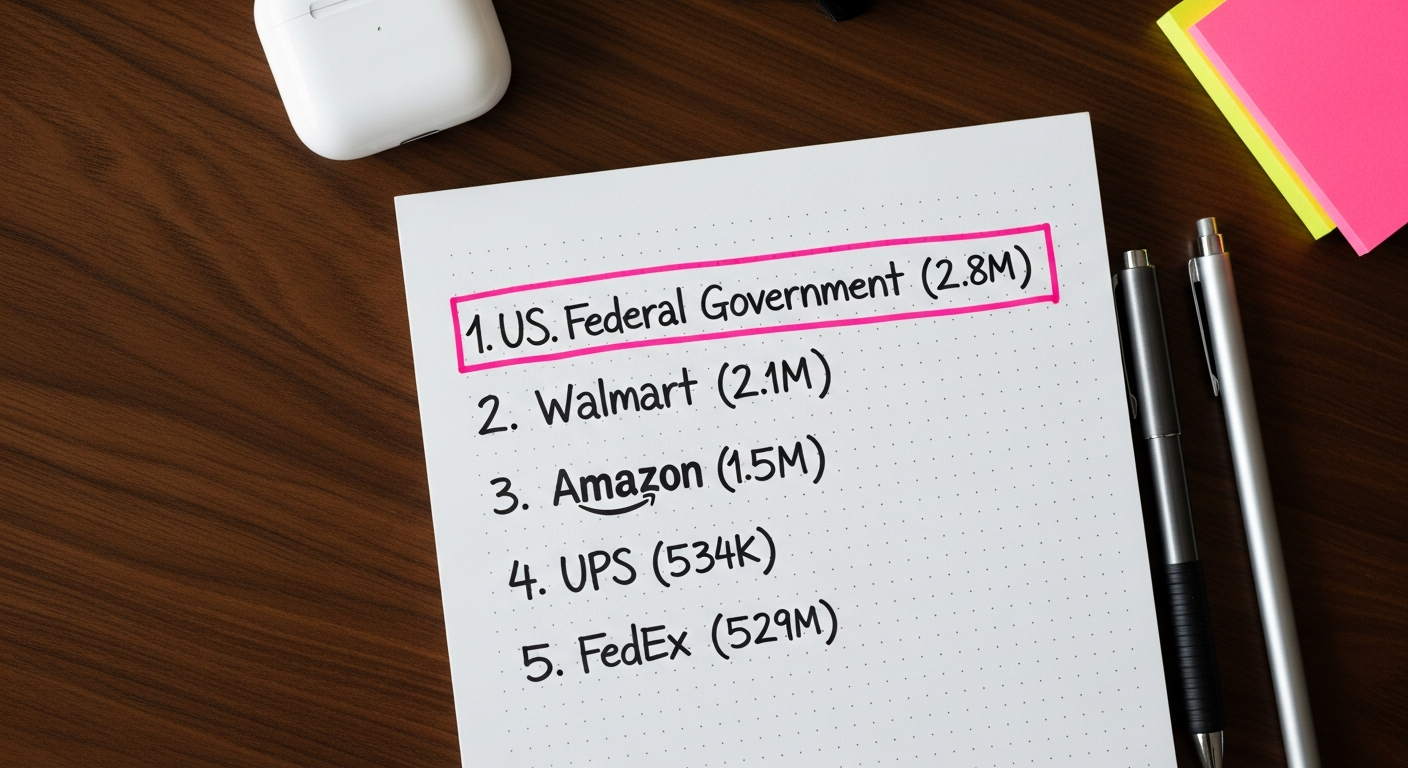
The US federal government stands as America's largest overall employer with approximately 3 million workers[1], while Walmart dominates the private sector with 2.1 million employees worldwide (roughly 1.6 million in the US)[2]. Amazon follows as the second-largest private employer at 1.55-1.58 million employees[3].
These three entities—government, Walmart, and Amazon—collectively employ more than 6.5 million Americans, shaping employment patterns across every state and industry sector.
This comprehensive guide breaks down America's largest employers by workforce size, sector, and geographic distribution. Whether you're researching market trends, identifying prospecting opportunities, or understanding the employment landscape, this data provides the complete picture of who employs America.
Top 50 Largest US Employers by Workforce Size
The landscape of America's biggest employers reflects a diverse mix of retail giants, healthcare conglomerates, logistics companies, and technology firms[4].
| Rank | Company | Employees | YoY Change |
|---|---|---|---|
| 1 | Walmart | 2,100,000 | 0% |
| 2 | Amazon | 1,556,000 | +2.0% |
| 3 | FedEx | 510,000 | -7.7% |
| 4 | UPS | 490,000 | -2.4% |
| 5 | Home Depot | 470,100 | +2.2% |
| 6 | Concentrix | 450,000 | Stable |
| 7 | Target | 440,000 | +6.0% |
| 8 | Marriott International | 418,000 | Stable |
| 9 | Kroger | 409,000 | Stable |
| 10 | UnitedHealth Group | 400,000 | Stable |
| 11 | Berkshire Hathaway | 392,400 | Stable |
| 12 | Starbucks | 381,000 | +5.5% |
| 13 | TriNet Group | 364,300 | Stable |
| 14 | TJX Companies | 364,000 | Stable |
| 15 | Costco | 341,000 | Growing |
| 16 | Cognizant | 336,800 | Stable |
| 17 | PepsiCo | 319,000 | Stable |
| 18 | JPMorgan Chase | 317,233 | +2.4% |
| 19 | HCA Healthcare | 316,000 | Stable |
| 20 | CVS Health | 300,000 | Stable |
| 21 | Albertsons | 285,000 | Stable |
| 22 | Aramark | 278,390 | Stable |
| 23 | IBM | 270,300 | Stable |
| 24 | Lowe's | 270,000 | Stable |
| 25 | Walt Disney Company | 231,000 | Stable |
| 26 | Citigroup | 229,000 | Declining |
| 27 | Microsoft | 228,000 | Stable |
| 28 | Wells Fargo | 217,000 | -5.0% |
| 29 | Dollar Tree | 214,710 | Stable |
| 30 | Bank of America | 213,000 | -1.9% |
| 31 | Darden Restaurants | 197,124 | Stable |
| 32 | Dollar General | 194,200 | Stable |
| 33 | Alphabet/Google | 190,167 | -6.0% |
| 34 | RTX Corporation | 186,000 | Stable |
| 35 | Comcast | 182,000 | Stable |
| 36 | Hilton Worldwide | 181,000 | Stable |
| 37 | Lear Corporation | 173,700 | Stable |
| 38 | Boeing | 172,000 | Stable |
| 39 | Ford Motor Company | 171,000 | Stable |
| 40 | Apple | 166,000 | Stable |
| 41 | General Motors | 162,000 | Stable |
| 42 | Oracle | 162,000 | Stable |
| 43 | GXO Logistics | 152,000 | Stable |
| 44 | McDonald's | 150,000 | Stable |
| 45 | Flex Ltd. | 147,979 | Stable |
| 46 | AT&T | 140,990 | Stable |
| 47 | CBRE Group | 140,000 | Stable |
| 48 | Johnson & Johnson | 138,100 | Stable |
| 49 | Barrett Business Services | 135,727 | Stable |
| 50 | Jabil Inc. | 135,000 | Stable |
Retail Sector Dominates Private Employment
The retail industry employs more Americans than any other private sector, with Walmart's 2.1 million workers representing nearly double the next largest retailer[4]. Home Depot (470,100 employees) and Target (440,000) follow as major retail employers, while grocery chains Kroger (409,000) and Albertsons (285,000) anchor the food retail segment.
| Company | Employees | Notable 2024 Updates |
|---|---|---|
| Walmart | 2,100,000 | World's largest private employer |
| Home Depot | 470,100 | +2.2% YoY; $18.25B SRS acquisition |
| Target | 440,000 | +6% YoY growth |
| Kroger | 409,000 | Pending $24.6B Albertsons merger |
| TJX Companies | 364,000 | +126 net new stores in 2024 |
| Costco | 341,000 | Continued expansion |
| CVS Health | 300,000 | Closing ~900 stores; 2,900 layoffs |
| Albertsons | 285,000 | Merger with Kroger pending |
| Lowe's | 270,000 | US-focused after international exits |
| Dollar Tree | 214,710 | Closing 600+ Family Dollar stores |
| Dollar General | 194,200 | Expansion despite challenges |
Walgreens (not publicly traded) operates approximately 8,000 stores with an estimated 200,000+ employees, though the company announced plans to close 1,200 locations over three years.
Healthcare Employs Millions Across Hospital Systems
Healthcare represents the fastest-growing major employment sector, with hospital employment increasing 8.3% since pre-pandemic levels—adding 434,000 positions[6]. UnitedHealth Group leads healthcare insurers with 400,000 employees, while HCA Healthcare anchors hospital systems at 316,000 workers across 220 hospitals[7].
| Company | Employees | Type |
|---|---|---|
| UnitedHealth Group | 400,000 | Insurance |
| HCA Healthcare | 316,000 | Hospitals |
| CVS Health | 300,000 | Pharmacy/Insurance |
| Kaiser Permanente | 216,000 | Integrated Care |
| Ascension Health | ~150,000 | Hospitals |
| CommonSpirit Health | ~150,000 | Hospitals |
| Elevance Health | 104,200 | Insurance |
| Universal Health Services | 99,000 | Hospitals |
| Tenet Healthcare | 98,000 | Hospitals |
| Cigna Group | ~70,000 | Insurance |
Hospital employment reached 5.66 million workers in February 2025, representing an 11% increase from pandemic lows and outpacing non-healthcare industries for 31 consecutive months[6].
Technology Giants Facing Workforce Contractions
The technology sector experienced significant workforce reductions through 2023-2024, with over 400,000 tech workers laid off across two years[8]. Despite these cuts, Amazon maintains the largest tech workforce at 1.55 million employees, though approximately 1.2 million work in warehouses and fulfillment rather than traditional tech roles[3].
| Company | Employees | YoY Change |
|---|---|---|
| Amazon | 1,556,000 | +2.0% |
| IBM | 270,300 | Stable |
| Microsoft | 228,000 | Stable |
| Alphabet/Google | 190,167 | -6.0% |
| Apple | 166,000 | Stable |
| Oracle | 162,000 | Stable |
| Intel | 108,900 | -15.0% |
| Cisco | 86,200 | -7.0% |
| Meta | 78,450 | +17% |
| Salesforce | ~72,000 | Declining |
Tech layoffs timeline: The sector eliminated 260,000 jobs in 2023 followed by 150,000-240,000 in 2024[8],[11]. Intel's 15,000-person reduction represented the largest single-company layoff, part of a $10 billion cost-saving initiative[10].
Logistics and Delivery Networks Employ Nearly One Million
The logistics sector's big three—FedEx (510,000), UPS (490,000), and Amazon's fulfillment operations (~1.2 million)—collectively employ approximately 2.2 million workers[4]. Both legacy carriers have reduced workforces as package volumes normalized post-pandemic.
| Company | Employees | YoY Change |
|---|---|---|
| FedEx | 510,000 | -7.7% |
| UPS | 490,000 | -2.4% |
| GXO Logistics | 152,000 | Stable |
| XPO Logistics | ~38,000 | Stable |
| J.B. Hunt | ~34,000 | Stable |
UPS announced 12,000 job cuts in January 2024 with an additional 20,000 reductions planned for 2025, reflecting both package volume declines and automation investments[12].
Fast Food Employs Millions Through Franchise Model
Fast food employment figures require distinguishing between corporate employees (reported in SEC filings) and total system employment including franchise workers. McDonald's reports 150,000 direct employees but its franchise network supports approximately 2 million jobs globally across 40,000+ restaurants[13].
| Company | Corporate Employees | Total System Jobs |
|---|---|---|
| McDonald's | 150,000 | ~2,000,000 |
| Starbucks | 381,000 | 381,000 |
| Darden Restaurants | 197,124 | 197,124 |
| Chipotle | 130,504 | 130,504 |
| Yum! Brands | 40,000 | ~1,000,000 |
| Restaurant Brands Intl. | ~4,000 | ~500,000 |
Starbucks added 20,000 employees year-over-year, though the company faces unionization at 370+ stores while adapting to new leadership under CEO Brian Niccol.
Federal Government: America's Largest Employer
The US federal government employs approximately 3 million workers when including USPS and military personnel, making it the nation's largest employer by a significant margin[1]. The federal civilian workforce (excluding postal workers) stands at approximately 2.3-2.4 million[14].
Federal Workforce Breakdown
Largest Federal Agencies by Employment
| Rank | Agency | Employees |
|---|---|---|
| 1 | Department of Defense (civilian) | 772,549 |
| 2 | Department of Veterans Affairs | 482,831 |
| 3 | Department of Homeland Security | 227,566 |
| 4 | Department of Justice | ~115,000 |
| 5 | Department of the Treasury | ~100,000 |
| 6 | Department of Health and Human Services | ~90,000 |
| 7 | Department of Agriculture | ~90,000 |
| 8 | Social Security Administration | ~60,000 |
Government vs. Private Sector Comparison
The federal government employs nearly twice as many workers as Walmart when comparing US-based employees. USPS alone (623,000) would rank among America's top five private employers.
USPS workforce trends: The Postal Service employs approximately 528,500 career employees and 94,500 pre-career workers[15]. This represents a dramatic decline from the peak of 909,000 workers in April 1999. Over 53% of craft employees will become retirement-eligible within the next decade.
Largest Private Employer by State: Complete 50-State Breakdown
Walmart dominates as the largest private employer in 24 states, primarily across the South and Midwest[18]. Healthcare systems lead in 17 states, particularly in the Northeast and West, while technology companies top the list in Washington (Amazon) and Oregon (Intel).
| State | Largest Private Employer | Employees |
|---|---|---|
| Alabama | Walmart | 40,884 |
| Alaska | Providence Health & Services | ~4,000 |
| Arizona | Banner Health | 50,000+ |
| Arkansas | Walmart | 54,712 |
| California | Kaiser Permanente | 183,000 |
| Colorado | UCHealth | ~34,000 |
| Connecticut | Yale New Haven Health | 29,468 |
| Delaware | ChristianaCare | ~11,100 |
| Florida | Publix | 160,000+ |
| Georgia | Walmart | 66,843 |
| Hawaii | Queen's Health Systems | 9,452 |
| Idaho | St. Luke's Health System | ~15,000 |
| Illinois | Walmart | ~57,000 |
| Indiana | Walmart | ~43,000 |
| Iowa | Hy-Vee | ~48,000 |
| Kansas | Walmart | ~22,000 |
| Kentucky | Walmart | ~31,000 |
| Louisiana | Walmart | ~37,000 |
| Maine | MaineHealth | ~21,000 |
| Maryland | Johns Hopkins Institutions | 51,725 |
| Massachusetts | Mass General Brigham | ~70,000 |
| Michigan | General Motors | ~52,000 |
| Minnesota | Mayo Clinic | 48,000+ |
| Mississippi | Walmart | ~25,200 |
| Missouri | Walmart | ~43,200 |
| Montana | Walmart | ~4,776 |
| Nebraska | University of Nebraska | 16,157 |
| Nevada | MGM Resorts International | 51,000-55,200 |
| New Hampshire | Walmart | 8,284 |
| New Jersey | Amazon | 49,000+ |
| New Mexico | University of New Mexico | 33,390 |
| New York | Northwell Health | 80,000+ |
| North Carolina | Walmart | 61,000 |
| North Dakota | Sanford Health | 15,000+ |
| Ohio | Walmart | 53,300-55,300 |
| Oklahoma | Walmart | 34,014 |
| Oregon | Intel | 17,000-22,000 |
| Pennsylvania | UPMC | 61,000 |
| Rhode Island | Lifespan | 14,000-16,000 |
| South Carolina | Walmart | 32,267-36,000 |
| South Dakota | Sanford Health | 12,187-17,000 |
| Tennessee | Walmart | 41,487-43,000 |
| Texas | Walmart | 171,531-177,000 |
| Utah | Intermountain Healthcare | 38,000-42,000 |
| Vermont | UVM Medical Center | 7,860-9,000 |
| Virginia | Walmart | 44,621-45,000 |
| Washington | Amazon | 80,000+ |
| West Virginia | WVU Hospital | 16,000 |
| Wisconsin | University of Wisconsin | 39,000-40,000 |
| Wyoming | Walmart | 4,699-5,000 |
Key Regional Patterns
- Southern and Midwestern states: Walmart dominates (Texas leads with 177,000 employees)[18]
- Northeastern states: Healthcare systems prevail (Northwell Health, Mass General Brigham, UPMC)
- Western states: Mix of healthcare and technology (Kaiser in California, Amazon in Washington)
- Florida exception: Employee-owned Publix (160,000+) beats Walmart (117,206)
Employment Trends: Healthcare Growth, Tech Contraction
The period from 2023-2025 witnessed dramatic workforce restructuring across sectors. Healthcare added hundreds of thousands of positions while technology eliminated over 400,000 jobs[6],[8]. Retail faced accelerating store closures, with 2025 layoffs up 274% versus 2024[5].
Fastest-Growing Major Employers
- Hospital sector: +434,000 positions since pre-pandemic (8.3% growth)[6]
- Amazon fulfillment: Continued hiring despite corporate layoffs[3]
- Chipotle: +13,740 employees (14% increase)
- Starbucks: +20,000 employees (5.5% growth)
- Target: +25,000 employees (6% growth)[5]
Largest Workforce Reductions (2023-2024)
| Company | Jobs Cut | Percentage |
|---|---|---|
| Meta | 21,000 | 25% (2022-23) |
| Intel | 15,000 | 15% (Aug 2024)[10] |
| Tesla | 14,000+ | 10%+ |
| Amazon | 27,000 | Corporate only[9] |
| Cisco | 10,000+ | 12% |
| 12,000 | 6% | |
| Microsoft | 10,000 | 5% |
| Salesforce | 7,350 | 10% |
Amazon's trajectory: Peak employment reached 1.62 million in Q1 2022 during the pandemic e-commerce surge. The company reduced to 1.52 million by 2023 before recovering to 1.58 million in late 2024—a workforce increasingly concentrated in fulfillment operations[3],[9].
Global Employer Rankings: Walmart's Worldwide Dominance
Walmart is the world's largest private employer with 2.1 million workers globally, nearly double second-place Amazon's 1.55 million[19]. Chinese companies BYD and JD.com round out the top four, reflecting China's manufacturing and e-commerce scale.
World's Top 20 Employers by Workforce
| Rank | Company | Employees |
|---|---|---|
| 1 | Walmart | 2,100,000 |
| 2 | Amazon | 1,556,000 |
| 3 | BYD | 968,900 |
| 4 | JD.com | 900,000 |
| 5 | Foxconn | 826,608 |
| 6 | Accenture | 791,000 |
| 7 | Volkswagen | 656,134 |
| 8 | Tata Consultancy Services | 607,979 |
| 9 | DHL Group | 594,879 |
| 10 | Compass Group | 580,000 |
| 11 | JD Logistics | 498,709 |
| 12 | UPS | 490,000 |
| 13 | Home Depot | 470,000 |
| 14 | Gazprom | 468,000 |
| 15 | China Mobile | 455,405 |
| 16 | Agricultural Bank of China | 454,716 |
| 17 | Concentrix | 450,000 |
| 18 | Teleperformance | 446,052 |
| 19 | Target | 440,000 |
| 20 | ICBC | 419,252 |
US companies dominate: Eight of the top 20 global employers are American, including five in the top 13 positions[19]. The US Department of Defense (2.86 million including military) would rank as the world's largest employer if including government entities[16].
BYD's remarkable growth: The Chinese electric vehicle manufacturer added approximately 200,000 employees in 2024 alone, climbing to the third-largest global employer as China's EV industry expanded[19].
Frequently Asked Questions: Key Employer Statistics
Conclusion: The Shifting Employment Landscape
America's employment landscape in 2025 reflects structural shifts accelerated by the pandemic and technological change. Walmart and Amazon together employ over 3.6 million workers—more than the entire federal government—solidifying retail and logistics as employment engines.
Healthcare's 8.3% growth since 2020 positions medical systems as dominant regional employers, with healthcare organizations leading employment in 17 states compared to Walmart's 24.
The technology sector's 400,000+ layoffs through 2023-2024 marked a significant workforce contraction, though companies like Amazon continued hiring for fulfillment operations even while cutting corporate positions.
Looking ahead, automation, artificial intelligence, and shifting consumer patterns will continue reshaping which companies employ the most Americans—though Walmart's century-long retail dominance and healthcare's demographic tailwinds suggest these sectors will remain employment leaders for years to come.
For sales and marketing teams targeting these major employers, understanding workforce composition and trends is essential for effective prospecting. Start with a clear ideal customer profile to narrow down which employers actually fit your offering. Then use tools like Data Surfer to identify the right contacts at these organizations with verified emails, phone numbers, and LinkedIn profiles. For more on finding decision-maker emails at large organizations, see our guide to finding anyone's email.
Sources
- [1]Pew Research Center - US federal workers: Key questions and employment trends
- [2]Wikipedia - Walmart
- [3]How To Buy SaaS - Amazon Employees In 2024
- [4]Ringover - The 50 Largest Employers in the U.S.
- [5]HRD America - Target corporate role cuts
- [6]Healthcare Financial Management Association - Hospital employment trends
- [7]Definitive Healthcare - Largest Health Systems in the U.S.
- [8]TechTarget - Tech sector layoffs explained
- [9]DemandSage - How Many Employees Does Amazon Have
- [10]Editorji - Tech Layoff Wave 2024
- [11]TechCrunch - 2024 tech layoffs archive
- [12]Entrepreneur - UPS layoffs announcement
- [13]MacroTrends - McDonald's Number of Employees
- [14]USAFacts - Federal government employment
- [15]USPS Office of Inspector General - Workforce Composition
- [16]USAFacts - US military demographic overview
- [17]Federal Pension Advisors - Federal Worker Statistics
- [18]World Population Review - Largest Employer by State 2025
- [19]RankingRoyals - World's Largest Companies by Employees 2024
- [20]WallStreetZen - Walmart Statistics 2025
Backed by startup programs from