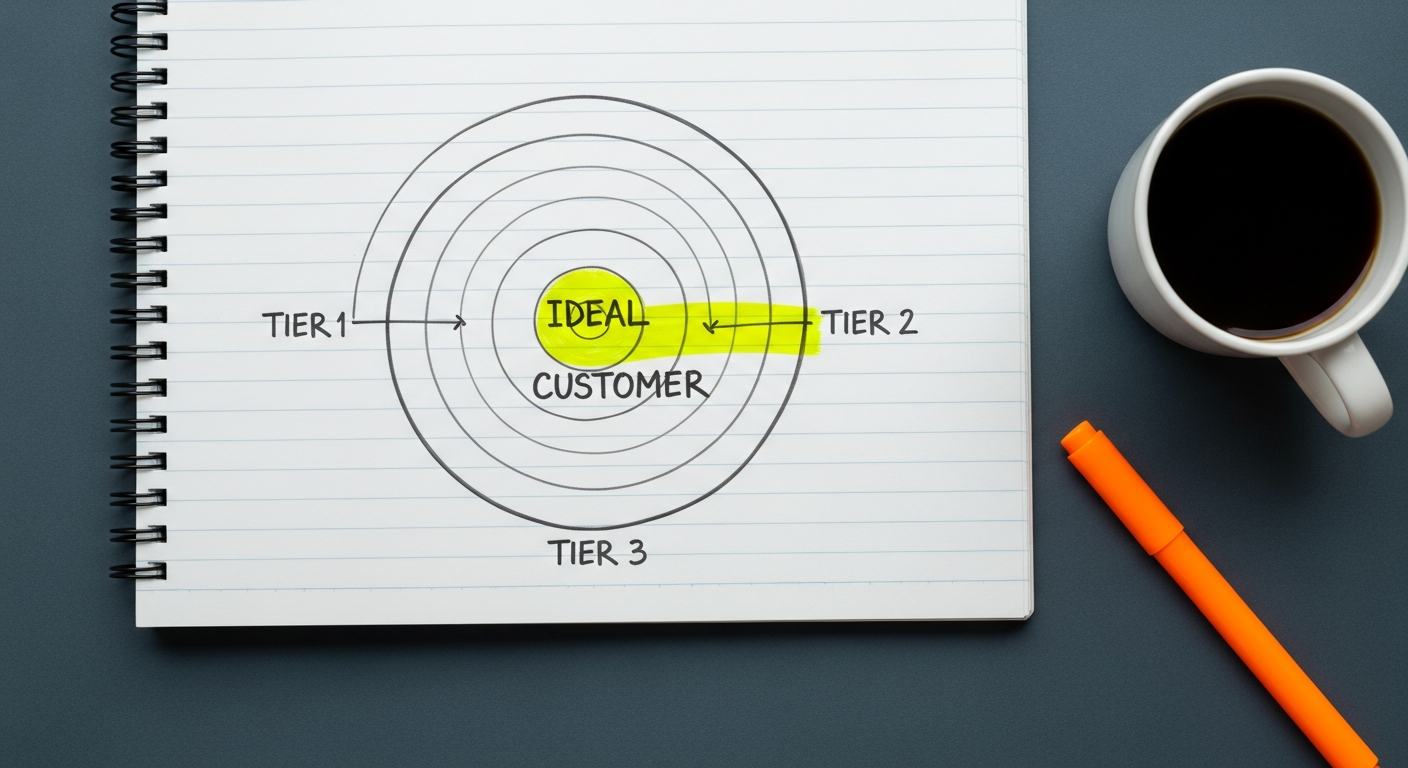
ICP Sales: How to Build an Ideal Customer Profile That Actually Converts
Table of Contents
Stop Chasing Bad-Fit Prospects
Every salesperson knows the frustration: you spend weeks nurturing a prospect, navigate endless discovery calls, finally close the deal, and within six months they've churned. The problem wasn't your pitch or your product. You were selling to the wrong company.
Companies with well-defined ICPs achieve 68% higher account win rates[1], not because they work harder, but because they work smarter by focusing on companies that actually need what they sell.
What is an ICP in Sales?
Gartner formally defines the Ideal Customer Profile as defining "the firmographic, environmental and behavioral attributes of accounts that are expected to become a company's most valuable customers."[2] The critical distinction from a generic "target customer" is specificity: an ICP identifies not just who might buy, but who represents the highest value and highest likelihood of purchase.
For example, rather than targeting "mid-sized companies," a well-crafted sales ICP might specify: "B2B SaaS companies with 50-200 employees, $5M-$30M in annual revenue, using Salesforce as their CRM, with at least one dedicated sales operations role, headquartered in North America."
ICP vs Buyer Persona: Understanding the Difference
The ICP versus buyer persona distinction causes frequent confusion but matters enormously for execution. HubSpot captures this relationship well: "Personas tell you who you're speaking to. ICPs tell you which companies are worth speaking to in the first place."
| Aspect | Ideal Customer Profile (ICP) | Buyer Persona |
|---|---|---|
| Focus | Company/Account level | Individual person level |
| Data type | Firmographics, technographics | Demographics, psychographics |
| Question answered | "Which companies should we target?" | "Who at those companies do we talk to?" |
| Example | "B2B SaaS, 50-500 employees, $5M-$50M ARRAnnual Recurring Revenue" | "VP of Sales, 35-50, uses Salesforce daily" |
The relationship between these concepts flows directionally. You define your ICP first to identify target accounts, then develop buyer personas to understand how to communicate with individuals within those accounts. An average ICP contains 3-5 distinct buyer personas representing different stakeholders in the buying committee.
Why Every Sales Team Needs a Documented ICP
The data is clear: organizations with a strong ICP achieve 68% higher account win rates[1]. This isn't a marginal improvement. It's the difference between a sales team that struggles to hit quota and one that consistently exceeds it.
The Statistics That Matter
- 81% of top-performing ABMAccount-Based Marketing: targeting specific high-value accounts organizations have confidence in their ICP, compared to only 42% of other organizations[1]
- ABM strategies produce 81% higher ROI compared to non-ABM tactics, with ICP as the foundation[3]
- Companies using ICP-aligned lead scoring report 38% higher lead-to-opportunity conversion rates
The Hidden Cost of No ICP
Without a clear ICP for sales, teams waste resources on prospects who were never going to convert. The costs compound: marketing generates leads that sales can't close, sales closes deals that customer success can't retain, and the entire organization chases vanity metrics rather than sustainable growth.
Signs Your Team Lacks a Clear ICP
- High churn rate despite closing deals
- Sales cycles that vary wildly in length
- Marketing and sales disagreeing on lead quality
- Reps saying "our ICP is the Fortune 500" (that's not an ICP)
- Customer success spending disproportionate time on a few difficult accounts
7 Essential Data Points for Your Sales ICP
Modern ICPs integrate multiple data categories, each serving distinct targeting and qualification purposes. Here are the seven categories you need to define:
| Category | Data Points | Why It Matters |
|---|---|---|
| Firmographics | Employee count, revenue, industry, location | Basic fit criteria |
| Technographics | Tech stack, tools used, platforms | Integration potential, sophistication |
| Business Model | B2B/B2C, subscription vs one-time, sales-led vs PLG | Alignment with your solution |
| Growth Signals | Hiring, funding, expansion | Budget and urgency indicators |
| Pain Alignment | Problems they have that you solve | Core value proposition fit |
| Budget Signals | IT spend, existing tool investment, procurement process | Ability to pay |
| Negative Criteria | Industries, sizes, or characteristics to exclude | Avoid wasted effort |
1. Firmographics
These are the foundational attributes: industry vertical (using NAICS/SIC codesStandard industry classification systems used to categorize businesses for precision), company size by employee headcount, annual revenue range, geographic location, and ownership structure (public, private, PE-backedPrivate Equity-backed: owned by investment firms). Most sales teams start here, but stopping here leaves significant value on the table.
2. Technographics
Particularly critical for software companies, technographics include the current technology stack, IT budget patterns, cloud maturity, and presence of competitor or complementary solutions. Knowing that a prospect uses Salesforce vs HubSpot vs Pipedrive completely changes your positioning and integration story. Sales intelligence platforms like Data Surfer, ZoomInfo, and Cognism provide technographic data, though enterprise platforms like ZoomInfo often require annual contracts starting at $15,000+.
3. Business Model Signals
Is the company B2B or B2C? Subscription or transactional? Sales-led or PLGProduct-Led Growth: users adopt the product before sales involvement? Enterprise-focused or SMBSmall and Medium-sized Businesses-focused? These attributes affect everything from price sensitivity to decision-making speed to the buying committee structure.
4. Growth Indicators
Companies in growth mode buy differently than those in maintenance mode. Key signals include recent funding rounds, aggressive hiring (especially in sales or the department you serve), new office openings, and public expansion announcements. These signals indicate both budget availability and organizational urgency. Tools like Data Surfer and Crunchbase track these growth signals, with Data Surfer alerting you automatically when target accounts show expansion patterns.
5. Pain Point Alignment
This moves beyond "what the company looks like" to "what problems the company has." As Theodore Levitt noted, people don't want a quarter-inch drill; they want a quarter-inch hole. Define the specific problems your solution addresses and identify observable signals that a company experiences those problems.
6. Budget Signals
Can they afford you? Look for signals like existing investment in similar solutions, public technology spending patterns, procurement sophistication, and fiscal year timing. A company that already spends on sales intelligence tools like Apollo, Lusha, or ZoomInfo has demonstrated both budget and belief in the category.
7. Negative Criteria
Equally important is defining who NOT to pursue. Drift reduced customer acquisition costs by 37% by explicitly excluding low-fit prospects. Common negative criteria include industries with low retention, company sizes with insufficient budget, geographies you can't serve effectively, and use cases your product doesn't support well.
How to Build Your ICP: Step-by-Step
Step 1: Analyze Your Best Customers
Start with data, not assumptions. Export your customer list and segment by lifetime value, retention rate, expansion revenue, and NPSNet Promoter Score: measures customer loyalty from -100 to 100 scores. Your ideal customer profile should be based on customers who generate the most value with the least friction. Look at your top 20% by revenue contribution, as they likely represent 60-70% of your total revenue.
Practical tip: Create a spreadsheet with columns for company name, annual contract value, tenure (months), NPS score, support tickets per month, and expansion revenue. Sort by a combined "customer health" score.
Step 2: Identify Common Patterns
With your best customers identified, look for shared characteristics. What industries appear most frequently? What's the typical employee count range? What tools do they use? What problems did they solve with your product? Document both quantitative patterns (80% are 50-200 employees) and qualitative ones (they all had a dedicated ops role).
Practical tip: Use sales intelligence tools to enrich your customer data with firmographic and technographic attributes you might not have captured during sales. Platforms like Data Surfer, Clearbit, and ZoomInfo can append company size, industry, tech stack, and growth signals to your existing customer list.
Step 3: Validate with Sales Team Input
Data only tells part of the story. Interview your top-performing sales reps about their best deals: What made those companies easy to sell to? What objections never came up? How did they describe their problems? This qualitative input reveals behavioral and cultural patterns that data alone misses.
Practical tip: Ask reps to describe their three favorite customers in terms of the buying process, not just the outcome. How they bought often matters more than what they bought.
Step 4: Document and Score Criteria
Transform patterns into specific, measurable criteria. Weight each criterion by its correlation with customer success. Not all ICP attributes are equally predictive: being in the right industry might be essential, while geographic location might be nice-to-have.
Practical tip: Create a scoring system: 0-100 points across your criteria, with minimum thresholds for "ICP fit." For example: 80+ = strong fit, 60-79 = moderate fit, below 60 = poor fit.
Step 5: Test and Refine
Your ICP is a hypothesis, not a fixed truth. Track win rates, cycle length, and retention for ICP-matching vs non-ICP accounts over the next quarter. If the differentiation isn't significant, your criteria need adjustment. Plan quarterly reviews to refine based on new data.
Practical tip: Set up a simple dashboard comparing ICP-fit vs non-ICP-fit deals on key metrics. If your ICP is accurate, you should see materially better performance for ICP accounts within 90 days.
ICP Template: Copy and Customize
Use this template as a starting point for documenting your ideal customer profile. Fill in each section based on your analysis of best customers.
Ideal Customer Profile Template
Firmographics
- Industry: [e.g., B2B SaaS, Professional Services, Manufacturing]
- Company Size: [e.g., 50-200 employees]
- Annual Revenue: [e.g., $5M-$30M ARRAnnual Recurring Revenue]
- Location: [e.g., North America, UK, DACHGermany (D), Austria (A), Switzerland (CH) region]
Technographics
- CRM: [e.g., Salesforce, HubSpot]
- Key Tools: [e.g., Uses Slack, Outreach, Gong]
- Tech Maturity: [e.g., Cloud-native, dedicated IT team]
Business Characteristics
- Business Model: [e.g., Subscription B2B, sales-led motion]
- Growth Stage: [e.g., Series A-C, growing 50%+ YoYYear-over-Year: compared to the same period last year]
- Team Structure: [e.g., Has sales ops role, 5+ SDRsSales Development Representatives: reps focused on outbound prospecting]
Pain Points
- Primary: [e.g., Spending 10+ hours/week on manual research]
- Secondary: [e.g., High cost of current data provider]
Buying Signals
- Trigger Events: [e.g., New sales leadership, recent funding, expansion]
- Intent Signals: [e.g., Researching sales intelligence tools, attending industry events]
Negative Criteria (Do NOT Pursue)
- [e.g., Companies under 20 employees]
- [e.g., Government or highly regulated industries]
- [e.g., Companies without dedicated sales function]
Using Your ICP for Prospecting
A documented ICP is useless if it stays in a drawer. The goal is to operationalize it across your prospecting workflow, from list building to outreach prioritization. Here's how to put your ICP into action.
Manual Research vs. Sales Intelligence Tools
You can apply ICP criteria manually by researching companies on LinkedIn, Crunchbase, and company websites. This works for small target lists but doesn't scale. Most teams find that sales intelligence platforms (like those in our Apollo alternatives guide) pay for themselves by reducing the hours spent on manual research while improving accuracy.
Lead Scoring Based on ICP Fit
Configure your CRM or sales engagement platform to score leads against ICP criteria automatically. Leads from companies matching your ICP should surface higher in rep queues. Companies using ICP-aligned scoring report 38% higher lead-to-opportunity conversion rates because reps spend time on the right accounts. AI tools can accelerate this process significantly; for a deeper look at how, see our AI for lead generation guide.
Intent-Based Prioritization
An account matching your ICP is good. An account matching your ICP and actively researching your category is better. Modern sales intelligence combines profile fit with intent signals to identify accounts that are both good fits and currently in-market. Enterprise intent platforms like Bombora and 6sense charge $30,000-$100,000+ annually. Data Surfer combines ICP-based fit scoring with real-time buying signals at a fraction of the cost, so you reach out when companies are actually ready to buy.
How Data Surfer Operationalizes Your ICP
Rather than just providing static contact data, Data Surfer analyzes your ideal customer profile and monitors target accounts for buying signals in real-time: hiring in roles you serve, website messaging shifts toward your category, fresh funding that unlocks budget, and competitive evaluation activity. This intent-based approach means you're reaching out at the right moment, not just to the right company.
Common ICP Mistakes to Avoid
1. Making It Too Broad
"Our ICP is the Fortune 500" is not an ICP. It's a wish list. Trish Bertuzzi of The Bridge Group warns: "The F500 is not a sweet spot, it's a huge target that can swallow up your resources without gaining any traction." Narrow to specific niches where your message resonates. LinkedIn campaigns targeting well-defined ICPs achieve 68% higher ROI compared to broad targeting.
2. Ignoring Negative Criteria
Most teams define who to target but neglect to define who NOT to target. Explicit negative ICP criteria prevent reps from wasting time on accounts that look attractive but never convert or quickly churn. Document the warning signs just as rigorously as the positive indicators.
3. Set-It-and-Forget-It Mentality
Markets shift, products evolve, and customer behavior changes. An ICP built two years ago may no longer reflect reality. Best practice calls for quarterly reviews with immediate reevaluation after major product launches, market shifts, or changes in conversion rate patterns.
4. Not Involving the Whole Revenue Team
ICP isn't just a sales document. Marketing needs it for targeting. Customer Success needs it for identifying at-risk accounts. Product needs it for roadmap prioritization. Build ICP collaboratively and communicate updates across all go-to-market teams to ensure alignment.
Frequently Asked Questions
Conclusion
An Ideal Customer Profile isn't a one-time exercise or a static marketing document. It's the foundation of efficient, effective B2B sales. When done right, your ICP becomes the filter through which every prospecting decision flows: which accounts to pursue, how to prioritize your time, and where to invest marketing resources.
The organizations that achieve 68% higher win rates aren't working harder. They're working smarter by focusing relentlessly on companies that actually need what they sell. Start by analyzing your best customers, document specific and measurable criteria, validate with your sales team, and commit to quarterly refinement.
The payoff is significant: shorter sales cycles, higher close rates, lower churn, and a sales team that spends time on winnable deals rather than chasing bad-fit prospects who were never going to convert.
Ready to put your ICP into action with intent-based prospecting?
Try Data SurferBacked by startup programs from