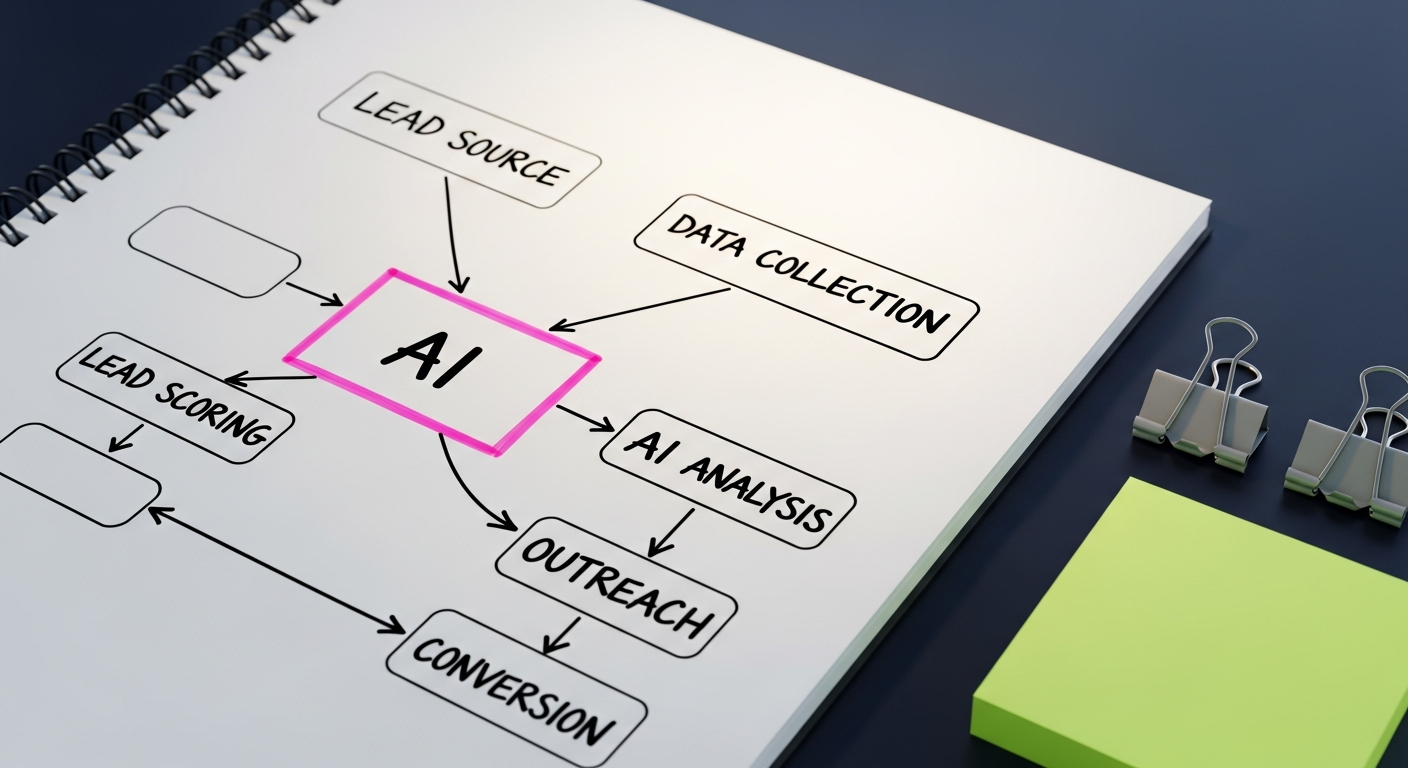
AI for Lead Generation: Complete 2026 Guide for B2B Sales Teams
Table of Contents
AI Lead Generation Has Gone Mainstream
AI lead generation has shifted from experimental to essential. In 2024, AI adoption in sales nearly doubled from 24% to 43%, with 81% of sales teams now experimenting with or fully implementing AI tools.[1] Teams using AI are 3.7x more likely to meet quota and save over 2 hours daily on manual tasks.[3]
This guide covers everything B2B sales professionals need to know about using AI for lead generation: what it is, how it works, which tools deliver results, and how to implement it without breaking your budget.
What is AI Lead Generation?
AI lead generation uses artificial intelligence, including machine learning, natural language processing, and predictive analytics, to automate finding, qualifying, and nurturing potential customers. Rather than replacing salespeople, AI handles high-volume research and qualification while humans focus on relationship-building.
The shift is dramatic: Gartner predicts 95% of seller research workflows will begin with AI by 2027, up from less than 20% in 2024.[5]
How AI Improves Traditional Lead Generation
| Traditional Method | AI-Enhanced Method | Impact |
|---|---|---|
| Manual Google/LinkedIn searching | AI-powered databases creating instant targeted lists | Hours to minutes |
| Individual email writing | AI-generated personalized outreach at scale | 2-3x response rates |
| Gut-instinct lead prioritization | Predictive scoring with data-driven likelihood | 75% higher conversions |
| Hours of prospect research | AI-curated intelligence delivered instantly | 60% time reduction |
| Static buyer personas | Dynamic behavioral analysis + real-time intent | First-mover advantage |
AI Lead Generation Statistics That Matter
Before investing in AI tools, understand what the data shows:
Adoption and Productivity
- 81% of sales teams are either experimenting with (40%) or have fully implemented (41%) AI[1]
- Sales professionals using AI daily are 2x more likely to exceed targets[2]
- Sellers using AI save 2 hours 15 minutes daily on manual tasks[3]
- Research time reduced from 11+ hours/week to ~5 hours with AI tools[4]
Conversion and ROI
- Machine learning lead scoring delivers 75% higher conversion rates vs. traditional methods
- Companies using AI-powered lead scoring see 50% increase in lead-to-sale conversion
- AI can reduce lead generation costs by 60%
- AI-using companies achieve $3.70 ROI per dollar invested (top performers: $10.30)
7 Ways to Use AI for Lead Generation
1. Finding and Verifying Contact Information
AI-powered sales intelligence tools scan public databases, company websites, social media profiles, and third-party data sources to compile contact information. Machine learning algorithms validate email addresses and phone numbers in real-time.
Example: Smartling (B2B translation SaaS) used Apollo's AI to automate prospect research, enabling their team to send 10x more personalized outreach emails.
Tools: Data Surfer, Apollo.io, ZoomInfo, Lusha, RocketReach
2. AI-Powered Prospect Research and Enrichment
AI analyzes firmographics (company size, revenue, industry), technographics (software used), website content, social media activity, and news events. Some tools track 150+ real-time buyer signals combined with proprietary insights.
Benefits: Reps save 3-5 minutes per lead on research (400+ minutes daily for 100 leads). Response rates improve 2-3x through better personalization.
Warning: "Hyper-personalization" has become hyper-obvious.
When everyone uses the same AI tools to scrape the same data points, the resulting "personalization" becomes a pattern that recipients recognize instantly. Opening with "I noticed you just raised a Series B" or "Saw your company is hiring for X role" no longer impresses anyone. The goal of research should be understanding context for genuine human engagement, not finding variables to slot into templates.
Tools: Data Surfer, Clay, Clearbit, ZoomInfo
3. Predictive Lead Scoring
AI lead scoring works through four stages:
- 1. Data Collection: Gathers behavioral signals (website visits, email interactions, downloads), demographic data, and historical conversion patterns
- 2. ICPIdeal Customer Profile: the type of company most likely to buy Creation: Machine learning creates your Ideal Customer Profile by analyzing past customers who converted
- 3. Pattern Recognition: Identifies patterns like "leads who visit pricing page twice in a week are 40% more likely to convert"
- 4. Score Assignment: Each lead receives a score (0-100) indicating conversion likelihood
Results: One company achieved a 30% increase in conversion rate within 6 months of implementing AI-powered predictive lead scoring.
Tools: Salesforce Einstein, HubSpot Predictive Scoring, 6sense, Microsoft Dynamics 365
4. AI Chatbots for Lead Capture
NLPNatural Language Processing: AI that understands human language-powered chatbots engage visitors 24/7, qualify leads through targeted questions, capture contact information naturally through conversation, route high-intent leads to sales reps, and sync data with CRMs.
Results:
- - KLM Royal Dutch Airlines boosted lead base by 40% and cut response times by 50x
- - David's Bridal AI chatbot "Zoey" sold $30,000 worth of dresses in weeks autonomously
- - HVAC company increased booking rate from 53% to 90% with automated qualification
Cost comparison: $1-2 per chatbot interaction vs. $6-14 for human agents.
Tools: HubSpot Chatbot (free), Drift, Intercom, Chatling
5. Automated Email Personalization
AI analyzes firmographic data, website behavior, social media profiles, and past interactions to dynamically insert personalized content. It optimizes send times based on recipient behavior patterns and A/B tests subject lines automatically.
Results:
- - 2-3x response rates across 800k+ cold emails monthly using AI personalization
- - 26% higher open rates and 29% higher response rates for personalized emails
- - Companies grow revenue 29% faster using AI email personalization
Warning: Recipients can smell AI fluff a mile off.
Everyone is now using AI to "personalize" their outreach. The result? Inboxes flooded with emails that say "I see you're in SaaS" or "Congrats on the recent funding round" followed by a generic pitch. This template-driven approach has become so common that prospects instantly recognize and ignore it. True personalization means having something genuine to say based on real context, not just inserting {{company_name}} into a template.
Tools: Autobound, Lyne.ai, SmartWriter, Instantly, Reply.io
6. Intent Signal Detection
Intent data indicates purchase interest through first-party signals (website visits, email interactions, chatbot engagement) and third-party signals (research on competitor sites, G2/TrustRadius reviews, topic-specific content consumption).
Platforms like Bombora monitor 460k+ B2B content sites and track 1.1 trillion+ intent signals monthly. AI distinguishes casual browsing from serious vendor research through "surge" detection.
Why it matters: Only 3-5% of potential customers are looking to buy at any time. Intent data identifies them, providing first-mover advantage.
Example: Demandbase, by integrating G2's buyer intent signals, qualified $3.5 million in new pipeline in a single quarter.
Tools: Data Surfer, Bombora, 6sense, Demandbase, UserGems
7. ICP Matching and Lookalike Modeling
AI analyzes your best customers to identify common traits (industry, company size, tech stack, revenue, buying triggers), examines 1,500+ signals including firmographics and buying intent, then generates lookalike audiences with similarity scores.
Example: A B2B SaaS company using AI lookalike prospecting achieved:
- - 40% reduction in outbound costs
- - 3x increase in qualified opportunities within 90 days
- - 2.5x improvement in outbound ROI
Tools: Data Surfer, Clay, Ocean.io, ZoomInfo, Telescope.ai
Best AI Lead Generation Tools Compared
Here's how the top AI lead generation tools stack up for B2B sales teams:
| Tool | Starting Price | Key Strength | Best For |
|---|---|---|---|
| Lusha | Free/$22/mo | LinkedIn Chrome extension | Small teams doing LinkedIn prospecting |
| Data Surfer | From $31/mo | Deep research + prospect warmup | Strategic engagement over mass outreach |
| Apollo.io | Free/$49/mo | All-in-one with sequences | Startups, mass email lists at scale |
| RocketReach | Free/$33/mo | Pay-as-you-go flexibility | Individual reps, ad-hoc prospecting |
| Clay | Free/$149/mo | 100+ data providers in one | Technical RevOps, custom workflows |
| Cognism | Custom | Verified mobiles, GDPR compliance | EMEA markets, phone-focused outbound |
| ZoomInfo | From $15K/yr | Largest database, intent data | Enterprise with budget for premium |
Data Surfer
Data Surfer is a B2B prospecting platform built for sales teams who believe generic outreach gets ignored. Rather than just providing contact lists, it focuses on helping you build genuine relationships through strategic engagement.
- Deep Research: Comprehensive prospect research that goes beyond firmographics to understand what actually matters to each contact
- Prospect Warmup: Track and engage with prospects through social touchpoints (likes, comments, follows) before direct outreach, with scoring to know when they're ready
- Automations: Build workflows that find, research, and qualify prospects on a schedule, delivering leads to your inbox
- Conversational ICP: Refine your ideal customer profile and research templates through natural conversation
The philosophy: real connection requires real context. Knowing when to reach out, understanding what matters to them, and having something genuine to say.
Apollo.io
AI-powered sales intelligence and engagement platform valued at $1.6B, trusted by 500,000+ companies including Autodesk and DocuSign.
Pricing:
- - Free: 250 emails/mo, 25 mobile credits
- - Basic: $49/mo - Unlimited emails, 75 mobile credits
- - Professional: $79/mo - 100 mobile credits, dialer, CRM integrations
- - Organization: $119/mo - 200 mobile credits, custom reports
Pros: All-in-one platform, affordable for SMBs, powerful automation
Cons: Credit system confusion, some data accuracy issues (see our full Apollo alternatives comparison)
ZoomInfo
Enterprise-grade go-to-market intelligence platform serving 35,000+ companies with the largest B2B database.
Pricing:
- - Free tier: 10-25 lookups/month
- - Professional: $14,995/year - 5,000 bulk credits
- - Advanced: $24,995/year - Intent data, technographics
- - Elite: $39,995/year - Full Copilot AI
Pros: Largest database, industry-leading intent data, enterprise-grade security
Cons: Expensive ($15K+ minimum), opaque pricing, US-centric data (see our ZoomInfo alternatives guide)
Lusha
AI-powered sales intelligence platform valued at $1.5B, focused on ease of use and compliance (ISO 27701 certified).
Pricing:
- - Free: 40-70 credits/month
- - Pro: $22.45/mo - 3,000-3,600 credits/year
- - Premium: $52.45/mo - 7,200 credits/year, bulk search
- - Scale: Custom - Unlimited seats, API access
Pros: Easy to use, excellent Chrome extension, affordable for SMBs, GDPR/CCPA compliant
Cons: Credit limitations, data accuracy varies by region
Cognism
Leading European B2B sales intelligence provider, trusted by 4,000+ companies. Specializes in GDPR-compliant contact data with phone-verified mobile numbers.
Pricing:
- - Platinum: $1,500-$10,000/year
- - Diamond: $2,550-$25,000+/year - Phone-verified Diamond Data
- - Enterprise: $15,100-$103,000/year
Pros: Excellent EMEAEurope, Middle East, and Africa data quality, phone-verified mobiles (3x higher connect rates), strong compliance
Cons: High pricing, weaker US SMB data, no built-in outreach
Clay
AI-powered data enrichment and workflow automation platform aggregating 100+ data providers. Trusted by 50,000+ teams.
Pricing:
- - Free: 100 credits (14-day access)
- - Starter: $149/mo - 2,000 credits/month
- - Explorer: $349/mo - 10,000 credits/month
- - Pro: $800/mo - 50,000 credits, CRM integrations
Pros: Unmatched data aggregation (100+ providers), powerful AI capabilities, flexible workflow builder
Cons: Steep learning curve, expensive at scale, CRM integrations require Pro plan
RocketReach
Lead intelligence platform with one of the largest contact databases. Serves 26M+ users including 95% of S&P 500 companies.
Pricing:
- - Free: 5 lookups/month
- - Essentials: $69/mo - 1,200 lookups/year
- - Pro: $119/mo - 3,600 lookups/year
- - Ultimate: $209/mo - 10,000 lookups/year
Pros: Massive database, affordable entry point, easy to use, good email accuracy (90-98%)
Cons: Credit limitations (no rollover), phone numbers less reliable
How to Implement AI Lead Generation (Step-by-Step)
Step 1: Audit Your Current State
Before implementing any AI tool:
- Document current lead generation processes, conversion rates, and pain points
- Record baselines: lead volume, conversion rates, time spent on tasks, cost per lead
- Identify your biggest pain point (low volume, low quality, slow response, poor personalization)
- Ensure CRM data is clean. AI is only as good as the data it analyzes
Step 2: Define Your ICP for AI Tools
Your ICP is the foundation AI tools build on. If you haven't documented yours yet, see our complete ICP guide for a step-by-step framework and template.
- 1. Analyze closed-won deals from past 1-2 years
- 2. Identify common traits: industry, company size, revenue, location, software used, buying triggers
- 3. Input data into AI tools (many can scan your website and CRM to auto-generate ICP profiles)
- 4. Validate with your sales team
- 5. Create negative signals marking attributes correlating with low close rates
Tip: Be specific. Avoid "SMB and enterprise" in the same ICP. Update quarterly based on new conversion data.
Step 3: Set Up Automated Prospecting Workflows
- 1. Signal detection: Set up triggers (intent data surge, website visit, job change)
- 2. Data enrichment: Auto-enrich leads with firmographic/contact data
- 3. ICP scoring: Score leads against ICP criteria
- 4. Routing rules: High-score leads to immediate sales outreach; medium-score to automated nurture; low-score to monitor
- 5. Personalized outreach: Generate AI-personalized emails based on prospect context
- 6. Follow-up automation: Auto-send follow-ups based on engagement (learn how to write follow-ups that add value)
Step 4: Integrate with Your CRM
Most AI tools offer native integrations with Salesforce, HubSpot, and other major CRMs:
- Sync bi-directionally: AI enrichment to CRM; CRM data to AI analysis
- Create custom fields for AI-specific data (intent scores, ICP match %)
- Set up workflow triggers based on AI signals
Case study: Prowly automated lead generation with HubSpot's AI CRM, achieving 30% increase in qualified leads and 20% reduction in sales cycle time.
Step 5: Measure ROI
| Metric | What to Track | Target Benchmark |
|---|---|---|
| Lead Volume | Leads generated per month | 2-3x increase |
| Lead Quality | MQLMarketing Qualified Lead to SQLSales Qualified Lead conversion | 25-30% improvement |
| Efficiency | Time on admin tasks | 2+ hours saved daily |
| Cost | Cost per lead | 40% reduction |
| Revenue | Average deal size | 30% increase |
| Sales Cycle | Time to close | 15-20% faster |
Common Challenges and How to Solve Them
Data Quality Issues
Nearly half (44%) of organizations manually review all AI-generated lead lists, undermining automation benefits.
Solutions:
- - Choose providers using first-party data sources
- - Implement continuous data validation
- - Use waterfall enrichmentQuerying multiple data providers in sequence until valid data is found strategies cross-referencing multiple sources (or use tools like Data Surfer that research like a human, adapting with context as they discover and explaining findings with citations)
- - Maintain human-in-the-loop oversight
Over-Relying on Automation
Enterprise prospects are 65% less likely to respond to purely automated emails compared to personalized outreach.
The AI outreach backlash is real.
Prospects have been bombarded with AI-generated "personalized" messages for years now. They can instantly spot the patterns: the formulaic opening referencing a LinkedIn post, the manufactured compliment, the pivot to a generic pitch. This has created widespread skepticism toward any outreach that feels templated. The irony? AI tools meant to save time are now costing responses because recipients have learned to filter them out.
Solutions:
- - Adopt a hybrid approach: AI handles initial outreach, humans handle relationships
- - Limit AI to high-volume top-of-funnel activities
- - Use AI for data enrichment and personalization suggestions; humans review messaging
- - Focus on timing and context over template variables. Knowing when to reach out matters more than knowing their job title
- - Build genuine relationships through social engagement before cold outreach
A hybrid approach has led to 50% increase in meetings and 22% rise in pipeline value.
Spam Filter Avoidance
Nearly 17% of B2B emails never reach the inbox.
Mass email is under siege.
Google and Yahoo now require bulk senders (5,000+ emails/day) to implement SPF, DKIM, and DMARC authentication. The critical threshold: if just 0.3% of recipients mark you as spam, your entire domain risks being flagged. Google recommends staying below 0.1%. Microsoft joined in May 2025 with similar requirements for Outlook, Hotmail, and Live.com. The era of "spray and pray" outreach is over.
Solutions:
- - Configure SPF, DKIM, and DMARCEmail authentication protocols that verify sender identity authentication
- - Gradually increase email volume (domain warming), but avoid automated warmup services. Google banned them in 2023 and will blacklist accounts using them. Microsoft and other providers are following suit. These services are easy to detect, especially when they insert unique tracking phrases into every email. Manual, organic warming is the only safe approach.
- - Use separate sending domains for cold outreach
- - Avoid spam trigger words
- - Regularly clean email lists
Budget Constraints
Budget remains the primary barrier for over 60% of small businesses.
Affordable options:
- - Data Surfer - From $31/month
- - Saleshandy - $25/month
- - HubSpot CRM - Free tier with AI features
- - Apollo - Free tier available
- - Instantly - Usage-based pricing
Most startups can start at $50-500/month. Average small business spends ~$1,800/year on AI tools.
Compliance (GDPR, CCPA, CAN-SPAM)
GDPR (Europe): Requires explicit consent OR legitimate business interest for B2B outreach. Fines up to 4% of global annual revenue.
CCPA (California): B2B exemption expired January 1, 2023. B2B data now fully subject to CCPA. Fines: $7,500 per intentional violation.
CAN-SPAM (US): Cold email IS legal if compliant. Requires accurate headers, non-deceptive subject lines, physical address, opt-out mechanism. Fines up to $53,088 per email in violation.
FAQ: AI for Lead Generation
Key Takeaways
- AI lead generation is now mainstream: 81% of sales teams are using or experimenting with AI
- The ROI is proven: Teams using AI are 3.7x more likely to meet quota and save 2+ hours daily
- Start with your biggest pain point: Low volume? Try AI prospecting. Low quality? Try predictive scoring. Slow response? Try chatbots.
- Human + AI is the winning formula: Don't fully automate; use AI to enhance human capabilities
- Budget-friendly options exist: Tools like Data Surfer (from $31/mo), Apollo, and HubSpot offer affordable plans to get started
Ready to try AI for lead generation?
Try Data Surfer from $31/monthDiscover qualified prospects with intelligent ICP matching and buying signal detection.
Backed by startup programs from