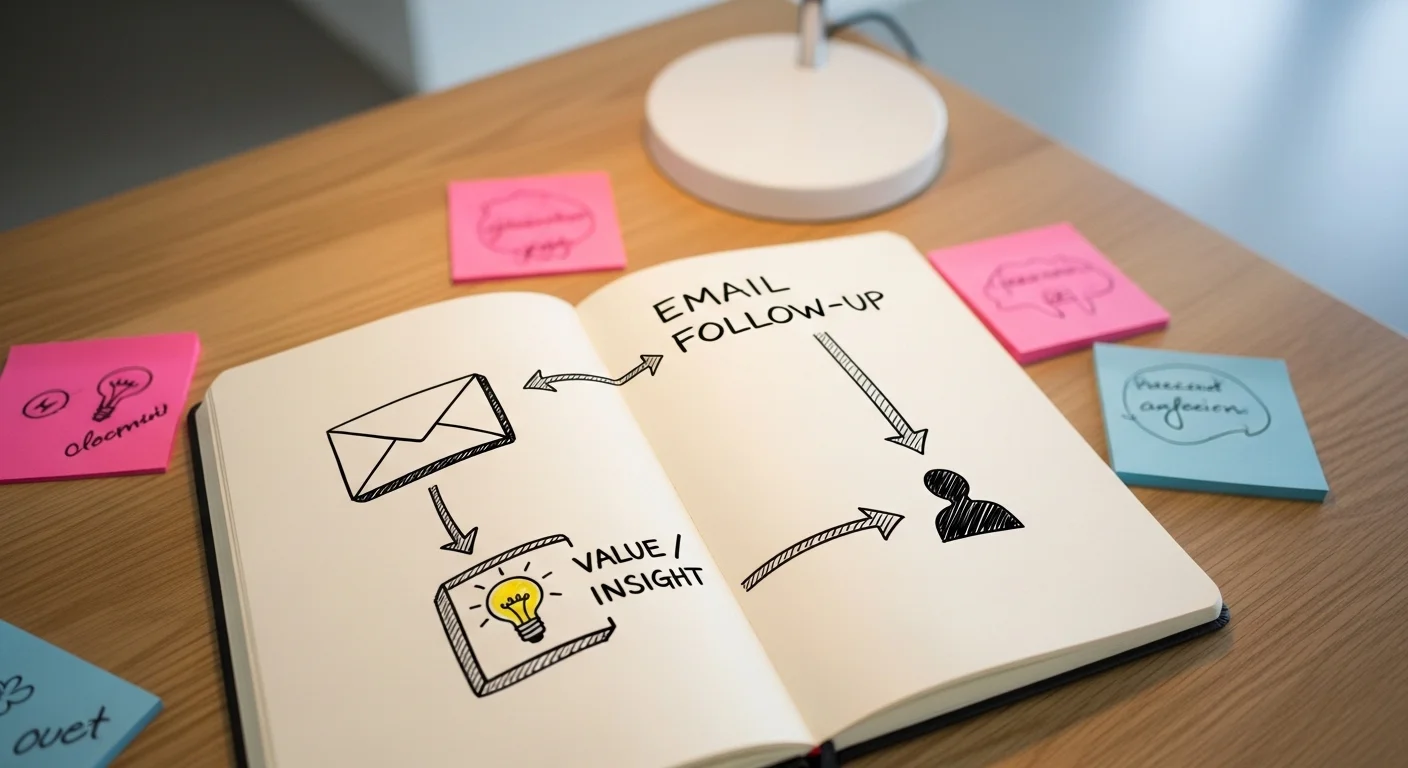
How to Write Cold Email Follow-Ups That Add Value
The single biggest reason cold email follow-ups fail isn't timing, subject lines, or even the number of touches. It's that 80% of follow-ups add zero new value. They're digital throat-clearing: "Just checking in," "Bumping this to the top of your inbox," "Wanted to circle back." These phrases signal to prospects that you have nothing new to offer, and your email deserves the same fate as the one before it: deletion.
Here's the uncomfortable truth: prospects don't ignore your follow-ups because they're too busy. They ignore them because your message doesn't clear the bar of "worth my time." Research from Belkins analyzing 16.5 million cold emails in 2024 found that response rates dropped 15% year-over-year, with the average reply rate now sitting at just 5.8%. Meanwhile, highly personalized, trigger-based campaigns still achieve 20-40% response rates. The difference isn't luck or timing. It's value.
Sales should be less cold through research and value, not through volume and persistence. Instead of teaching you to follow up more times or with cleverer subject lines, we'll build a framework for follow-ups that genuinely help prospects, whether they buy from you or not. (For a broader cold email strategy including infrastructure and templates, see our B2B cold email playbook.)
Table of Contents
Why Do Generic Follow-Ups Fail So Spectacularly?
The psychology of email response is unforgiving. Research shows that 71% of recipients cite lack of relevance as the primary reason they ignore sales emails. Decision-makers receive an average of 10+ cold emails per week, and most are irrelevant. Their brains enter what psychologists call "threat detection mode," filtering out perceived noise to protect limited attention.
Generic follow-ups trigger this filter instantly. Phrases like "just checking in" or "wanted to follow up" contain no new information and no reason to engage. They communicate: "I have nothing valuable to say, but I'm hoping persistence will work."
The data confirms this. According to Gartner, only 24% of decision-makers receive a valuable email even once per week. When you send a "checking in" follow-up, you've just confirmed you're not in that 24%.
The Counterintuitive Finding
Follow-ups absolutely work when done right. Woodpecker's research shows a single follow-up increases replies by 22%, and campaigns with 4-7 emails generate 3x more responses than 1-3 email campaigns. The problem isn't following up. It's following up with nothing to offer.
The Persistence Gap
Marketing Donut's widely-cited research found that 80% of sales require five follow-ups, yet 44% of salespeople give up after just one. Those who persist with value-adding touches capture the majority of opportunities. Those who persist with "just checking in" capture spam complaints.
What Is a Value-Based Follow-Up Framework?
Value-based follow-ups operate on a simple principle: every touch should give the prospect something useful, regardless of whether they respond or buy. Each valuable interaction builds trust, demonstrates expertise, and positions you as a resource rather than a pest.
There are three types of value you can add in follow-ups, and effective sequences rotate through all three:
The framework works by cycling through these value types across your sequence. Follow-up one might share new information about a trigger event. Follow-up two offers an insight or resource related to their likely challenges. Follow-up three presents social proof from a similar company. Each touch adds something; none simply asks again.
Research from Hunter.io analyzing 11 million emails found that smaller, highly targeted campaigns with deep personalization and value-first messaging outperform broad blasts by 2.76x. That targeting starts with a well-defined ideal customer profile (see our ICP guide).
The challenge is finding enough new information for each touch. Data Surfer monitors target accounts continuously, catching changes that manual research misses: subtle website copy shifts, new team pages, updated product positioning. These details give you fresh, specific angles for each follow-up.
How Do You Research Between Follow-Up Touches?
Value-based follow-ups start with systematic research. Not occasional Googling, but a consistent process that uncovers relevant information between each touch. This research identifies trigger events, company news, and individual activity that transforms generic follow-ups into timely, relevant conversations.
Trigger Events Worth Monitoring
Trigger events represent moments when companies become dramatically more likely to buy. Research indicates that trigger-based campaigns achieve up to 497% higher engagement than standard cold outreach. The reason is psychological: trigger events create new priorities, new budgets, and new urgency.
High-value triggers
- Executive changes (new C-suite hires have 90 days to make an impact)
- Funding rounds (companies with fresh capital face pressure to deploy it)
- Job changes of existing contacts (champions who move to new companies)
Secondary triggers
- Leadership promotions
- Mergers and acquisitions
- Hiring surges (indicating expansion)
- Product launches
- Office relocations
Companies acting on these triggers within 24-48 hours see the highest response rates.
How Data Surfer Tracks Trigger Events
Most tools only track the obvious stuff: funding rounds and job changes. Data Surfer monitors accounts over time for subtle shifts that signal buying intent: website messaging changing from B2C to B2B language, new product pages appearing, job descriptions mentioning your category, or tech stack changes. These micro-signals often indicate a company is moving toward a purchase decision before any press release or LinkedIn update.
Building Your Monitoring System
Start with free tools
Google Alerts remains underutilized. Create alerts for target company names combined with trigger keywords: "[Company Name] + funding," "[Company Name] + hiring," "[Company Name] + new VP." Set delivery to "as-it-happens" for high-priority accounts. You can create up to 1,000 alerts covering your entire prospect list.
LinkedIn Sales Navigator
Approximately $100/month, provides the richest trigger data for B2B sales. Save target accounts and leads, then monitor alerts for job changes, promotions, company news, hiring activity, and, critically, when saved account employees visit your company page. This last signal indicates active research and should trigger immediate outreach.
For larger teams
Intent data platforms like Bombora, 6sense, and ZoomInfo Intent track when companies research topics related to your solution. These platforms represent significant investment ($15K-$50K+ annually) but provide signals invisible to manual research.
Data Surfer
Starting at $31/month, Data Surfer monitors target accounts for changes that Google Alerts and LinkedIn miss: website copy shifting from B2C to B2B messaging, new product pages appearing, job descriptions adding keywords in your category, pricing page updates. These subtle signals often precede public announcements by weeks, giving you a reason to reach out before competitors notice.
The 5-Minute Pre-Send Research Routine
Before sending any follow-up, invest five minutes in targeted research:
| Time | Action | What You're Looking For |
|---|---|---|
| 0:00-1:00 | LinkedIn profile check | Recent posts, job changes, promotions, shared content |
| 1:00-2:00 | Company news search | Press releases, funding, product launches, media mentions |
| 2:00-3:00 | Trigger alert review | Google Alerts, Sales Navigator notifications |
| 3:00-4:00 | Content check | New podcasts, articles, webinar appearances |
| 4:00-5:00 | Engagement review | Opens, clicks, forwards from previous touches |
This brief routine transforms "just following up" into "I noticed [specific thing] and thought this might be useful." The prospect immediately recognizes they're not receiving a mass email. You've done the work to make this relevant.
Automate Your Pre-Send Research
Data Surfer can automate most of this research by continuously monitoring social profiles for both companies and key contacts, plus their websites and competitors. Instead of manually checking LinkedIn and company news before each follow-up, you receive alerts when something changes, giving you ready-made reasons to reach out.
What Personalization Actually Moves the Needle?
Every article on cold email follow-ups mentions personalization. Few explain what actually works versus what has become noise.
Basic personalization has diminished returns
First names in subject lines once boosted open rates by 26%. That advantage has largely evaporated as every sales tool automates this. Company name mentions and job title references face similar fatigue. These remain baseline expectations, not differentiators.
Contextual personalization still works
This means referencing specific company initiatives, recent news, or content the prospect created. Mentioning their LinkedIn post from last week, their recent podcast appearance, or their company's just-announced partnership demonstrates genuine attention. The response rate boost from this level of personalization reaches 30-52% compared to template-only approaches.
Hyper-personalization achieves breakthrough results
Custom video mentioning their company by name, specific analysis of their competitive positioning, or reference to their exact tech stack and how you integrate. These approaches achieve 40-60% reply rates in tested campaigns. Martal Group found that campaigns with multiple deep personalization touchpoints produced 142% higher response rates than generic alternatives.
Beyond Merge Fields: What to Personalize
Warning about AI personalization: Most AI-generated personalization is surface-level garbage. Without proper context, AI just paraphrases something obvious from their LinkedIn headline or company About page. Effective AI personalization requires feeding it real intelligence: changes over time, competitor moves, specific initiatives. Tools like Data Surfer provide this context so AI can write something that actually demonstrates you did your homework.
Reference their content
"Your recent post on [topic] resonated, especially your point about [specific insight]. It made me think about how [connection to your value]."
Bad AI: "I loved your post about leadership. Great insights!"
With context: "Your post last Tuesday about ditching quarterly planning got me thinking. You mentioned the 6-week cycle experiment. We saw similar results with 3 clients who switched."
Acknowledge their initiatives
"I saw [Company] just launched [new product/feature]. Companies at this growth stage typically face [challenge]. Curious if that's on your radar."
Bad AI: "Congrats on your company's growth! Exciting times ahead."
With context: "Noticed you added HIPAA compliance to your security page last month. That usually means healthcare deals are in the pipeline. We help companies like yours pass vendor security reviews 3x faster."
Address their competitive landscape
"Most companies evaluating [competitor] find that [specific limitation]. Here's how [similar company] approached the same decision."
Bad AI: "I see you're in the CRM space. It's competitive out there!"
With context: "Saw that Acme Corp just launched a free tier last week. When competitors go freemium, conversion usually drops 15-20%. Here's how two of your peers responded."
Connect to their tech stack
"I noticed you're running [tool they use]. We integrate natively to solve [specific problem that integration addresses]."
Bad AI: "I see you use Salesforce. We integrate with Salesforce!"
With context: "Noticed you added Snowflake to your jobs page requirements 2 weeks ago. Teams making that migration usually struggle with real-time sync to their CRM. We built a connector specifically for that."
Leverage mutual connections
"I was speaking with [mutual connection] last week, and your name came up around [topic]. She suggested I reach out directly." Warm introductions convert dramatically higher; even mentioning a mutual connection adds legitimacy.
Bad AI: "I see we're both connected to Richard on LinkedIn. Small world!"
With context: "Richard Walshe mentioned you're rebuilding your outbound motion after the reorg last month. He thought our approach to signal-based prospecting might help. Worth a 15-min call?"
The key distinction: effective personalization references information that took effort to find. If it's visible in their email signature or LinkedIn headline, it's table stakes. If it required reading their content or following their company news, it registers as genuine attention.
Skip the Manual Research
Finding tech stack info, company news, and competitive context manually takes 10-15 minutes per prospect. Data Surfer tracks companies over time and flags changes others miss: a pricing page that now mentions enterprise, job posts seeking skills in your category, website language shifting from "startup" to "scale-up." These details make personalization specific instead of generic.
How Do You Read Buying Signals in Follow-Up Sequences?
Not all engagement is equal. Learn to tell curiosity from intent so you can focus follow-up energy where it matters and adjust based on actual prospect behavior.
Signal Interpretation Hierarchy
High-intent signals
- -Link clicks (especially pricing pages, case studies, demo requests)
- -Multiple opens within a short window (3+ opens in a day)
- -Forward activity (multi-threading within the organization)
- -Any reply, even objections
Demand immediate action - call within 24 hours
Medium-intent signals
- -Single open with no reply
- -Repeated opens over several days
- -Social engagement (likes/comments on your content after receiving email)
Require nurturing - next touch needs stronger value
Low or negative signals
- -No opens after 3+ sends
- -Quick unsubscribes
- -Spam complaints
Indicate adjustment needed - pause for 90 days or cease outreach
Adjusting Your Approach Based on Signals
Multiple opens + pricing page clicks: Escalate immediately. Call within 24 hours. This prospect is actively evaluating and may be comparing you to competitors simultaneously.
Repeated opens but no clicks or replies: Your value proposition isn't compelling enough. Your next touch should offer different value. Perhaps the original angle didn't resonate, but a case study featuring their specific challenge might.
Forward activity detected: Shift to multi-threading mode. Research other stakeholders at the organization and develop parallel outreach. You've likely entered an internal conversation you can influence.
3+ touches with zero engagement: Pause outreach for 90 days before refreshing your approach. Continuing to email prospects who don't open is list hygiene neglect that damages deliverability and wastes resources.
Generic vs. Value-Based Follow-Ups: Side-by-Side
The difference between generic and value-based approaches is obvious in direct comparison. Here's the framework applied across common B2B scenarios.
SaaS Sales Example
Generic Approach
Subject: Following up
Hi Sarah,
Just wanted to follow up on my previous email about our CRM platform. Let me know if you have any questions or would like to schedule a demo.
Thanks,
[Name]
Value-Based Approach
Subject: Saw your Q4 hiring plans - relevant case study
Hi Sarah,
Noticed on LinkedIn that DataTech is planning to add 15 sales reps in Q1. When Finova scaled from 20 to 45 reps last year, their biggest challenge wasn't hiring. It was maintaining follow-up consistency as the team grew. Their response times went from 2 hours to 2 days.
We helped them implement a system that kept response times under 4 hours even at scale. Attached a one-pager on how they did it. Figured it might be relevant as you plan the expansion.
Worth a conversation about how you're thinking about this?
[Name]
The value-based version references a specific trigger (hiring plans), connects it to a relevant challenge (scaling follow-up consistency), provides social proof from a similar situation, and offers concrete value (the case study) regardless of whether Sarah responds.
Recruiting Follow-Up Example
Generic Approach
Subject: Checking in on the software engineer role
Hi Marcus,
Just bumping this to the top of your inbox. Let me know if you'd like to discuss the Senior Engineer opportunity at CloudScale.
Best,
[Name]
Value-Based Approach
Subject: CloudScale's new ML initiative - why now matters
Hi Marcus,
I saw CloudScale just announced their machine learning product line expansion. Based on your background leading ML infrastructure at Vertex, this seems like unusually good timing. They're building the exact capabilities you helped pioneer there.
The hiring manager mentioned they're specifically looking for someone who's scaled ML pipelines from prototype to production. That's literally what you did with Vertex's recommendation engine.
I don't want to oversell it, but I'd be doing you a disservice not to flag the alignment here. 20 minutes this week to share more details?
[Name]
Partnership Outreach Example
Generic Approach
Subject: Following up on partnership discussion
Hi Jennifer,
Wanted to circle back on my previous email about a potential partnership between our companies. Please let me know if this is something you'd like to explore.
Regards,
[Name]
Value-Based Approach
Subject: Your integration request thread on the community forum
Hi Jennifer,
I came across your community forum post asking about analytics integrations for mid-market clients. It looks like you've received 40+ upvotes but no solution yet.
We actually built something addressing this exact gap. Our API handles the transformation layer that's causing friction for your implementation team. Two of your competitors have integrated it, but I noticed you haven't explored the option.
I wrote up a quick technical brief on how the integration works and what your team would need to implement it. Attached, no strings. If it's interesting, happy to connect with your engineering lead to walk through it.
[Name]
The pattern: value-based follow-ups show research, connect to specific situations, and offer something useful whether the recipient responds or not. Generic follow-ups just ask for the same thing again.
What Should You Check Before Sending Any Follow-Up?
Research without a consistent process becomes sporadic. Use this checklist to ensure every follow-up meets a value threshold before hitting send.
Information Freshness
- Checked prospect's LinkedIn activity in the past 48 hours?
- Searched for recent company news?
- Reviewed trigger alert notifications?
Value Identification
- Contains new information the prospect doesn't have?
- Includes a useful insight, resource, or perspective?
- References relevant social proof specific to their situation?
- Would this email provide value even outside a sales context?
Personalization Depth
- References something beyond name, company, and title?
- Could NOT be sent unchanged to someone else in their role?
- Personalization connects to your value proposition?
Timing and Signals
- Checked engagement signals from previous touches?
- Spacing follow-ups appropriately (2-5 days minimum)?
- Is there a trigger event making this timing relevant?
If a follow-up fails multiple checklist items, it's not ready to send. Either conduct more research to add value or wait until you have something worth saying.
Which Tools Enable Value-Based Follow-Ups at Scale?
Research-first follow-ups require tools. The right stack makes systematic personalization feasible without hours per email.
Trigger and Intent Monitoring
LinkedIn Sales Navigator remains the most cost-effective starting point for B2B teams. Account and lead alerts surface job changes, company news, and hiring activity.
Google Alerts costs nothing and covers news that LinkedIn misses. Create alerts for target company names combined with trigger keywords.
Crunchbase tracks funding rounds, acquisitions, and leadership changes for technology companies.
For teams with budget, intent data platforms like Bombora, 6sense, and ZoomInfo Intent reveal when companies research topics related to your solution.
Research and Personalization
Clay automates the research process, pulling data from dozens of sources to enrich prospect records with relevant personalization variables.
Apollo.io combines contact database with sequencing and includes useful personalization variables beyond basics.
Data Surfer helps with prospect research specifically. Company intelligence tools identify relevant context for personalized outreach, including buying signals and verified contact information, before you ever send the first email.
Multi-Channel Execution
The data strongly supports multi-channel follow-ups: combining email with LinkedIn produces 30-40% more replies than email alone. Lemlist and Expandi enable LinkedIn automation alongside email sequences.
The warning with multi-channel: coordinate your messaging. References to previous touchpoints ("I sent you an email earlier this week...") create coherence. Isolated touches across channels feel disorganized.
The Real Goal of Follow-Ups
Stop thinking about follow-ups as persistence. Your job is to provide enough value that responding becomes the obvious choice.
Follow-ups require research time, not just scheduling. Measure success by value delivered, not just meetings booked. Treat non-responders as humans who deserve respect, not obstacles to overcome through volume.
Generic follow-ups achieve 1-5% response rates and generate inbox fatigue. Value-based approaches consistently hit 20-40% when executed well. Five deeply researched follow-ups will outperform 50 templated ones.
Before your next follow-up, ask one question: "What value does this add that my previous email didn't?" If you can't answer clearly, don't send it. Instead, do more research, find a relevant trigger event, curate a useful resource, or wait until you have something worth saying.
Summary: Generic vs. Value-Based Follow-Ups
| Generic Follow-Ups | Value-Based Follow-Ups |
|---|---|
| "Just checking in" | References specific trigger event |
| Same message repeated | New value type each touch |
| Name + company personalization | Content/initiative/context personalization |
| Asks for same meeting | Offers resource first |
| Treats persistence as strategy | Treats value delivery as strategy |
| 1-5% response rate | 20-40% response rate |
| Creates inbox fatigue | Builds credibility over time |
| Stops after 1-2 touches | Sustains 4-7 touches with new value |
One approach treats prospects as targets to convert. The other treats them as people who deserve help. The data shows which works better. The only question is whether you'll do the research required to execute it.
Build Your Research Foundation with Accurate Data
Every framework in this article performs better when built on accurate prospect data. Data Surfer helps sales teams research accounts, identify key decision makers, and source verified emails before the first message goes out, so your value-based follow-ups land with the right people.
Start Researching SmarterFrequently Asked Questions
Backed by startup programs from